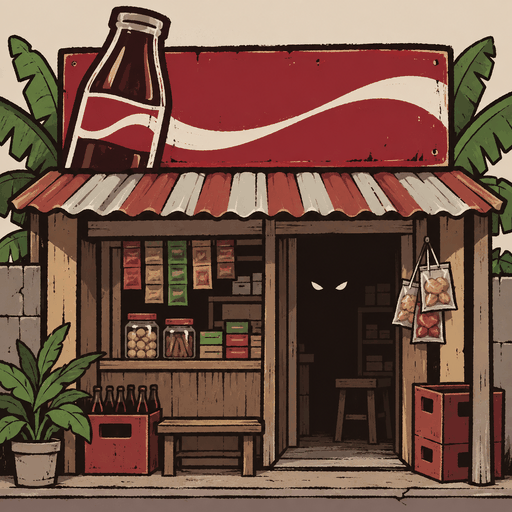
Narinig Mo Ba Story: Premise, Themes, Sari-Sari Store & Creators
Explore the Narinig Mo Ba story, its sari-sari store setting, psychological horror themes, Game Jam Los Baños origins, and creator-confirmed context.
Last updated: 2026-09-10
The Narinig Mo Ba story works because it begins with something ordinary. You are placed behind the counter of a Filipino sari-sari store, where regular customers come for everyday goods and conversation. The creators describe Narinig Mo Ba? as a story-driven psychological horror game disguised as a cozy sari-sari store simulator. That description is the key to understanding the Narinig Mo Ba story: the store is not a distraction from the horror. It is the mechanism through which the horror arrives.
This page stays mostly spoiler-light. It explains the premise, setting, themes, title, and development context without turning the final reveal into a plot summary.
What is the Narinig Mo Ba story about?
At the start, the player takes the role of a small neighborhood store owner. Customers arrive, ask for products, pay, receive change, and talk. Those visits gradually expose information about the people living nearby. The official premise says the player will gather gossip and piece together a tragic, whispered truth hidden by the neighborhood.
The Narinig Mo Ba story therefore has two layers operating at once. On the surface, you are working. Underneath, you are listening. A product request creates a reason for a character to stand at your counter; the conversation creates a reason for you to remember them.
The developers also frame the central event as a desperate act of survival that triggers a chain reaction. That wording matters because it refuses to present the neighborhood as a simple good-versus-evil mystery. Desperation suggests context, pressure, consequences, and people making choices before the player fully understands them.
What does “Narinig Mo Ba?” mean?
“Narinig mo ba?” is naturally understood as “Did you hear?” or “Have you heard?” in Filipino/Tagalog, depending on context. It is a perfect title for a game built around neighborhood conversation.
The Narinig Mo Ba story repeatedly turns listening into action. Gossip can be casual entertainment, social information, warning, distortion, or evidence. A line heard over the counter may seem unimportant when it first appears and become more meaningful later.
The phrase also creates uncertainty. “Did you hear?” is not the same as “Did you see?” Information has already passed through another person. That distance fits psychological horror, where the player is often forced to decide which impressions and accounts deserve trust.
Why the sari-sari store is central to the story
A sari-sari store is a familiar part of everyday life in many Philippine neighborhoods: a small convenience shop that sells goods in practical quantities and functions as a point where neighbors naturally cross paths.
That makes it an unusually effective setting for the Narinig Mo Ba story. The player does not need a detective's office or a supernatural laboratory. People bring the world to the counter themselves.
The shop also creates a boundary. You are inside, customers are outside, and the counter separates private space from public life. Yet conversation passes through that boundary easily. The official description's phrase about the store being “left open both ways” turns this physical layout into a narrative idea: the store receives the neighborhood, but it also leaves the player exposed to what the neighborhood carries.
Cozy presentation versus psychological horror
Narinig Mo Ba uses contrast instead of starting with constant threat. The creators tag the project as Cute and Horror at the same time. Players on the official comment page repeatedly describe the art and early gameplay as cozy, then talk about being surprised by the later shift.
The Narinig Mo Ba story needs that comfort. If every frame looked dangerous, the player would enter defensive mode immediately. By asking you to serve ordinary customers and become comfortable with the shop, the game establishes a baseline. Changes in sound, dialogue, pacing, or atmosphere feel stronger because you know what “normal” looked like first.
This is also why reading a full spoiler before playing can flatten the experience. The Narinig Mo Ba story is short, and much of its design depends on the difference between what you expect from the opening and what the later scenes imply.
Gossip as a story mechanic
In many games, dialogue is a reward between mechanical sections. Here, dialogue is part of the mechanic. The store transaction keeps your hands busy while conversation keeps your attention on the people.
The Narinig Mo Ba story treats repeated names, worries, absences, and neighborhood references as pieces of a larger social picture. You are encouraged to remember not only what a customer buys but what they say while buying it.
That gives the title another meaning. Hearing something does not automatically mean understanding it. A rumor can be true in detail but wrong in interpretation, or wrong in detail but reveal something important about the speaker. Psychological horror thrives on that gap.
Is Narinig Mo Ba based on a true story?
The developers have not publicly described Narinig Mo Ba as a recreation of a specific true case in the official sources used for this guide. The safest description is that it is a fictional horror story built around recognizable Filipino community life.
That distinction is important. The Narinig Mo Ba story can feel culturally specific without needing to claim that every event comes from reality. Its sari-sari store, local conversation style, money handling, and social relationships provide a recognizable framework for an invented narrative.
Who made the Narinig Mo Ba story?
The itch.io project credits six creator accounts: doppie, yuriellll, oreocapybara, Krarneas, csr_eio, and karinasaurus. The team refers to itself as VC Studios.
The creators have described themselves as college students, and one creator confirmed in the official comments that the original game-jam version was made in four days for Game Jam Los Baños 2026. The official jam page lists Narinig Mo Ba among 30 entries.
That origin explains the project's compactness. The Narinig Mo Ba story is not built like a fifty-hour role-playing campaign. It concentrates on one location, a small cast of visitors, a repeated work loop, and a controlled change in tone.
No generative AI and the visual identity
The official itch.io metadata includes the “No AI” tag, and the release credits emphasize in-house artwork. That matters to the Narinig Mo Ba story because the hand-made visual identity is part of what gives the shop its friendly first impression.
The cute presentation is not simply decoration. It creates the emotional distance the horror later has to cross. Players in the official comments frequently mention the art, ambience, music, and dialogue together rather than treating them as separate features.
Why the game went viral
VC Studios said in its September 2026 devlog that Narinig Mo Ba had recently gone viral across social platforms in the Philippines. The team thanked creators who featured the game and players who took time to play and donate.
There is no single official metric that explains the spread, so it is better not to invent one. But the shape of the Narinig Mo Ba story helps explain why it is easy to share: it has a culturally recognizable hook, a cozy visual identity, a short runtime, a strong tonal turn, and moments that create reaction-video material without requiring hours of setup.
The fact that mobile support became one of the team's most requested features also shows that interest expanded beyond traditional desktop itch.io players. See Narinig Mo Ba mobile for the current status.
Narinig Mo Ba story themes
The clearest themes are gossip, community, survival, consequences, and the gap between hearing and knowing. The official description directly supports the ideas of hidden neighborhood secrets, a tragic whispered truth, and a desperate act with consequences.
A cautious reading of the Narinig Mo Ba story asks several questions rather than forcing one answer. What happens when serious information travels as gossip? When does a listener become responsible for acting? How well do neighbors understand one another? What can be hidden inside a place that looks completely familiar?
Those questions are more useful than immediately labeling every unusual event supernatural. The creators call the game psychological horror, which leaves room for fear to come from people, interpretation, memory, social pressure, or something less explainable.
Should you read the ending explanation?
If you have not played yet, start with how to play Narinig Mo Ba or the spoiler-light Narinig Mo Ba walkthrough. The Narinig Mo Ba story is compact enough that a blind first run is worth preserving.
If you have finished and want to separate confirmed events from interpretation, continue to the Narinig Mo Ba ending page.
Sources
This Narinig Mo Ba story overview is grounded in the official Narinig Mo Ba itch.io page, the creators' September 2026 devlog, official developer comments, the doppie creator profile, and the Game Jam Los Baños 2026 entry list.
For practical play information, see Narinig Mo Ba download and how to play Narinig Mo Ba.