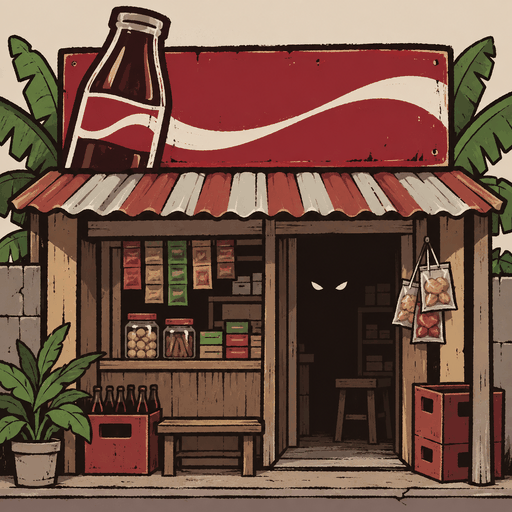
Narinig Mo Ba Ending Explained: Spoilers & Clues
Narinig Mo Ba ending guide with spoiler warnings, confirmed story context, final-sequence interpretation, clue analysis, and notes on alternate-ending claims.
Last updated: 2026-09-10
Major spoiler warning: this page is for players who have already finished the game. If you are still playing, use the Narinig Mo Ba walkthrough first and return here afterward.
The Narinig Mo Ba ending is effective because the game spends most of its short runtime teaching you to feel safe in an ordinary routine. You serve people at a sari-sari store, handle products and money, and listen to neighborhood gossip. By the time the tone fully changes, those everyday interactions have already given the final sequence emotional context.
This Narinig Mo Ba ending explanation separates what the creators publicly confirm from interpretation. That matters because search results now contain claims about “secret endings,” “bad endings,” and detailed lore that the official project page does not independently confirm.
What the Narinig Mo Ba ending is built to resolve
The official premise gives three strong anchors. First, the neighborhood has secrets. Second, the player gathers gossip and gradually pieces together a tragic truth. Third, a desperate act of survival has caused a chain reaction.
Those statements tell us what the Narinig Mo Ba ending is supposed to reframe: the store visits were never isolated errands. Each conversation is part of a network of people living around the same hidden crisis.
The ending therefore works backward. Once the game reveals how serious the situation is, earlier comments and tonal shifts feel different. What sounded like ordinary chismis becomes information the player should reconsider.
The final horror turn
Players on the official itch.io discussion repeatedly describe the end as the moment where the cozy experience becomes frightening. Community accounts refer to a strong late scare and a disturbing final discovery. Because the official store page does not publish a complete scene-by-scene ending synopsis, this guide avoids inventing a canonical line of dialogue or a named culprit where the creators have not documented one publicly.
The important Narinig Mo Ba ending fact is the structural one: the game delays its strongest horror until the player is comfortable. The reveal is not disconnected from the earlier store routine; it is the consequence of paying attention to the neighborhood around that routine.
If you want the exact visual sequence rather than interpretation, the most reliable source is the playable game itself on the creators' itch.io page.
Why the ending feels stronger than a normal jumpscare
A jumpscare can surprise you without changing the story. The Narinig Mo Ba ending aims for more than that. The sound and visual escalation arrive after a period of ordinary work, so the surprise also changes how you remember the earlier scenes.
This is a classic contrast mechanism: establish safety, repeat it until the player trusts it, then introduce information that makes the trusted setting uncertain. In Narinig Mo Ba, the sari-sari store is especially effective because it is socially open. Customers come to the counter voluntarily. Gossip enters the store before danger does.
The Narinig Mo Ba ending turns that openness into vulnerability. The phrase in the official description about the store being “left open both ways” becomes more ominous once the player understands that the shop is connected to whatever has been happening outside.
Is there one ending or multiple endings?
The developer sources checked for this page do not publish an official ending flowchart, a list of alternate endings, or named “good,” “bad,” and “secret” routes.
That means a page claiming a guaranteed Narinig Mo Ba ending route should provide evidence from the game or a direct developer statement. At the moment, it is safer to describe the released title as a short, mostly linear story experience unless the creators later document branching conclusions.
Players may use phrases such as “bad ending” or “secret ending” informally because the final reveal is dark or because the horror is hidden behind the cozy opening. Those search terms do not by themselves prove that separate unlockable endings exist.
How to interpret the Narinig Mo Ba ending
A good interpretation starts by separating four kinds of information:
- Direct observation: what the player actually sees or hears in the game.
- Character claims: what one person says happened.
- Repeated neighborhood information: details that appear through more than one conversation.
- Atmospheric suggestion: music, pacing, visual changes, or framing that creates meaning without stating a fact.
The Narinig Mo Ba ending becomes clearer when you do not treat those categories as equally reliable. Gossip is central to the story precisely because reported information can be useful without being complete.
Ask what you learned directly, what you only heard from someone else, and which earlier detail became meaningful only after the final sequence. That method produces a stronger explanation than attaching a supernatural theory to every scary image.
The title and the ending
“Narinig mo ba?” can be translated as “Did you hear?” or “Have you heard?” That question is not just flavor text. It describes the player's position throughout the story.
You are a listener. You receive fragments while working. The Narinig Mo Ba ending tests whether those fragments have added up to understanding.
There is also a moral tension in the title. Hearing something serious creates a question about responsibility. When does gossip become a warning? When does a rumor deserve attention? When does someone who keeps listening become a bystander rather than a neutral observer?
The official premise's reference to a desperate act of survival supports this reading more strongly than a simple “monster attacks store” interpretation. The ending is connected to consequences inside a community.
Psychological horror versus supernatural certainty
The creators classify the game as psychological horror. That label does not automatically mean “nothing supernatural happens,” but it does suggest that uncertainty, perception, fear, and interpretation are important.
For that reason, the Narinig Mo Ba ending should not be reduced to a supernatural explanation unless the game clearly establishes one. An unsettling sound can signal danger without proving a ghost. A frightening image can be literal, symbolic, or both. A contradictory conversation can show deception, misunderstanding, trauma, or incomplete information.
The strongest Narinig Mo Ba ending theories explain several parts of the game at once: the title, the shop, the gossip, the gradual tonal shift, and the chain reaction mentioned by the creators.
Why a second playthrough helps
Narinig Mo Ba was created as a compact game-jam project, so clues are concentrated. On a second run, you no longer need to spend as much attention learning the store layout or worrying about what the ending will be. That frees you to listen for setup.
Replay the opening conversations slowly. Notice when the soundtrack changes. Pay attention to repeated names or concerns. Separate what characters know from what they assume. The Narinig Mo Ba ending often feels less sudden on replay because the early scenes can now be read as preparation.
Use how to play Narinig Mo Ba if you want a controls refresher before replaying.
Is the ending unfinished because the game was made in four days?
One creator confirmed on the official itch.io comment page that the original Game Jam Los Baños version was made in four days. The team has also called themselves mostly first-time game developers and acknowledged that parts of the jam project were rushed.
That does not mean every ambiguity in the Narinig Mo Ba ending is automatically an accident. Short psychological horror frequently leaves interpretation open on purpose. At the same time, it is fair to distinguish intentional ambiguity from details the small team may expand or polish in future updates.
The developers have said they will continue making games and improving previous ones, but they have not announced a dated Narinig Mo Ba sequel in the official statements reviewed here.
Narinig Mo Ba ending FAQ
Is there a secret ending?
No separate secret ending is confirmed by the official sources checked for this article. Treat guides claiming a secret route as unverified unless they show reproducible in-game evidence.
Is there a bad ending?
The final sequence is dark enough that players may call it a bad ending, but the creators have not published an official route list using that label.
Is the ending supernatural?
The project is psychological horror, and the official premise does not settle every interpretation. Base conclusions on what the game directly shows rather than assuming every strange event has one supernatural cause.
Will there be a sequel?
The creators have said they have other work in progress and will continue making games, but there is no firm public Narinig Mo Ba sequel date in the sources checked here.
What should I read after the ending?
Read the Narinig Mo Ba story page for a spoiler-light thematic overview, then replay the game or compare the Narinig Mo Ba walkthrough with what you remember.
Sources
This Narinig Mo Ba ending guide uses the creators' official itch.io release, official comment thread, mobile/support devlog, and the Game Jam Los Baños 2026 submissions for confirmed development context. Interpretive sections are labeled as interpretation rather than presented as developer-confirmed canon.